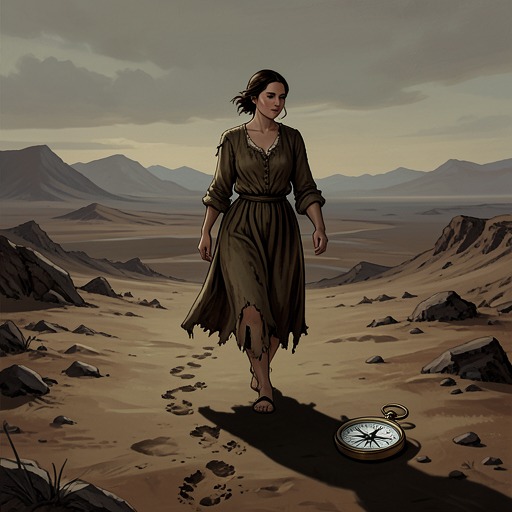
Musselman
Here There Is No WhyThe Musselman is Chaim Lerner’s name for an Auschwitz prisoner whose life force has disappeared: a walking zombie, still human but seemingly emptied of soul. In his Kabbalistic account, the figure becomes the dark counterpart to survival. Chaim argues that God granted survivors extra chayut, or vitality, but calls this a mystical answer without ultimate meaning—a belief that matters to him precisely because it cannot resolve the horror it addresses.
The Figure in the Camp
Chaim explains that prisoners recognized a Musselman immediately. The person’s eyes were blank, and the life force seemed gone; Chaim says death would follow within days, whether the prisoner collapsed, was shot for disobedience, or was selected. The term, which he identifies as German for Muslim, strikes him as a strange choice whose origin nobody knows. His description makes the Musselman more than a label for physical decline: it names the apparent loss of the animating force that, in his account, distinguishes a living person from someone already nearing death.
Chayut and the Survivors
Chaim places the Musselman within a Kabbalistic scheme of five levels of soul, or life force. He describes chayut as the fourth level and the highest available to human beings; the fifth belongs to God, or to what he calls the mythic or transcendent level. He says that level cannot be accessed or discovered, then turns to the human one: in his theory, prisoners who became Musselmen had been granted lower levels of life force, while survivors received extra measures of chayut through an explicit creative act by God.
Chaim insists this is not a matter of genetics, reward, or punishment. His own family makes the distinction painfully difficult: his father and brother became Musselmen, though Chaim says they were better men than he was—stronger, more intelligent, and more generous. The theory therefore does not let survival stand as evidence of superior character. Instead, it attributes the difference to an inscrutable divine act, one that leaves moral worth and survival sharply divided.
An Answer That Does Not Explain
Chaim calls chayut the mystical answer to the question of how some people survived, but immediately qualifies the answer as ultimately meaningless. It is, he says, important to him nonetheless. That tension is central to the concept: it offers a religious vocabulary for survival without claiming that the Holocaust can be made coherent or that its victims’ fates can be justified.
The interview then tests this account against Holocaust writers who died by suicide. The interviewer raises what is called the Paul Celan syndrome—the survivor, poet, and suicide—and asks how such deaths fit a theory of survivors blessed with extra vitality. After a long pause, Chaim wonders whether writing reveals human evil at the cost of the writer’s life. He notes that the writers did not leave suicide notes and suggests that perhaps their work is their note. The question remains unresolved: chayut describes the force that allowed some to live, but does not explain why survival could coexist with despair or why a survivor might later die by suicide.
The Competing Image of the Writer
The book places Chaim’s theory beside Bella Shmozic’s account of Holocaust writers as people who see too much. Shmozic calls Chaim “the six million and first victim, and the eighth Holocaust writer,” situating his death among writers who took their own lives. She reads a story he published a year before his death—about a blind man who suddenly gains sight, is overwhelmed by what he sees, and dies of a tumor—as an allegory for the burden of witnessing. In her interpretation, the writer’s capacity to see horror without mediation becomes fatal.
That account does not disprove Chaim’s idea of chayut; it exposes what the idea cannot settle. The Musselman marks the loss of life force in the camp, while the survivor-writer’s later death raises a different question: whether endurance can itself become unbearable. Between Chaim’s religious explanation and Shmozic’s image of vision overwhelmed by horror, the concept remains both an answer and an admission that no answer makes the losses meaningful.